Back in the mid 1970's, Andrew Moorhouse released four peanut scale models, originally under the name "Bluebird Models", but this seems to have been dropped later.

I currently have three of them, as you can see above, though the Comper Swift kit is incomplete. The fourth model is a Wittman Tailwind, illustrated below.

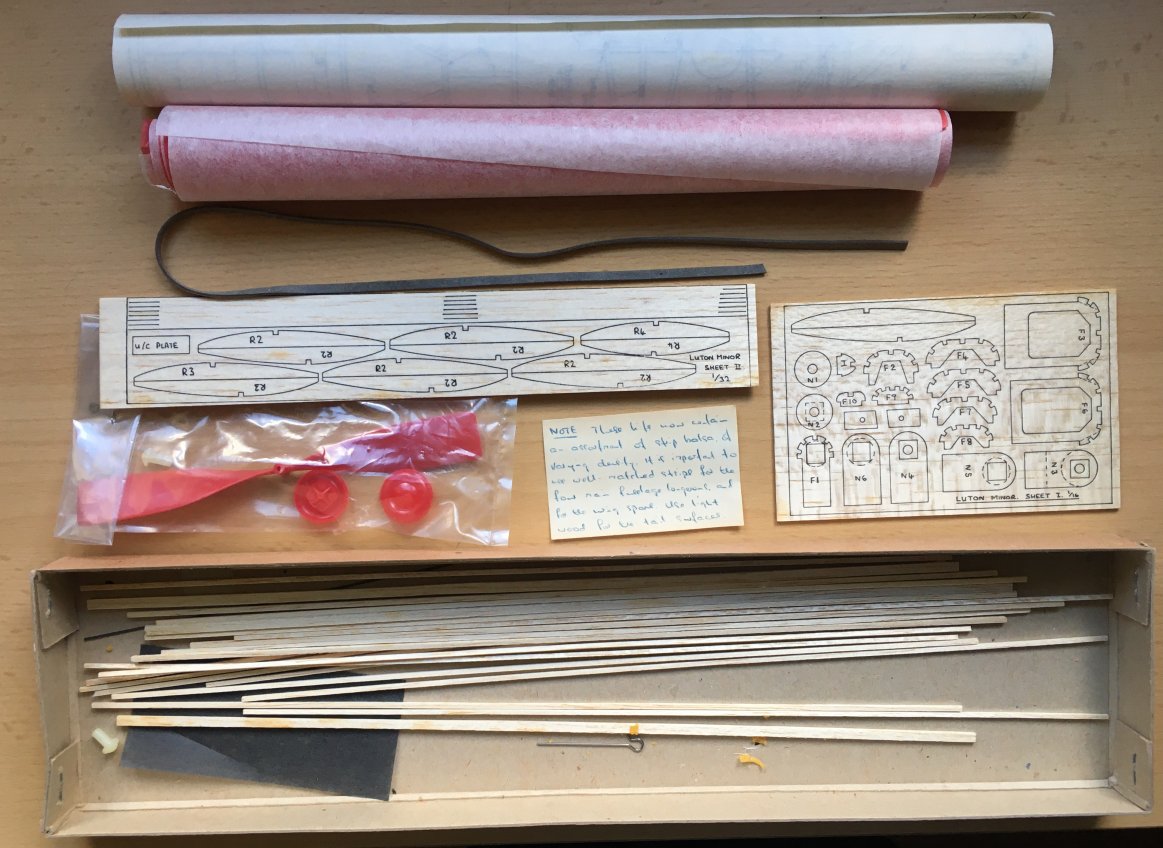
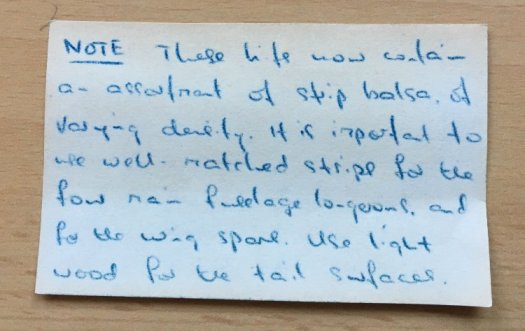
Here are the contents of the Luton Minor kit, dated 1975 on the plan, making the kit (at the time of writing) 46 years old. It certainly gives the impression of being put together with care - the tissue and plan are both rolled to avoid creases. A strip of dark 1/8" rubber is included which I suspect would be a bit fierce for an indoor model. Red and white tissue is supplied, plus black for the lettering, which from the slightly open weave looks to me like lightweight Modelspan. The 1/16" strip wood is of good quality with a mix of lighter and heaver, stiffer strip. I love it that the hand written note below was included in the kit (excellent advice!)
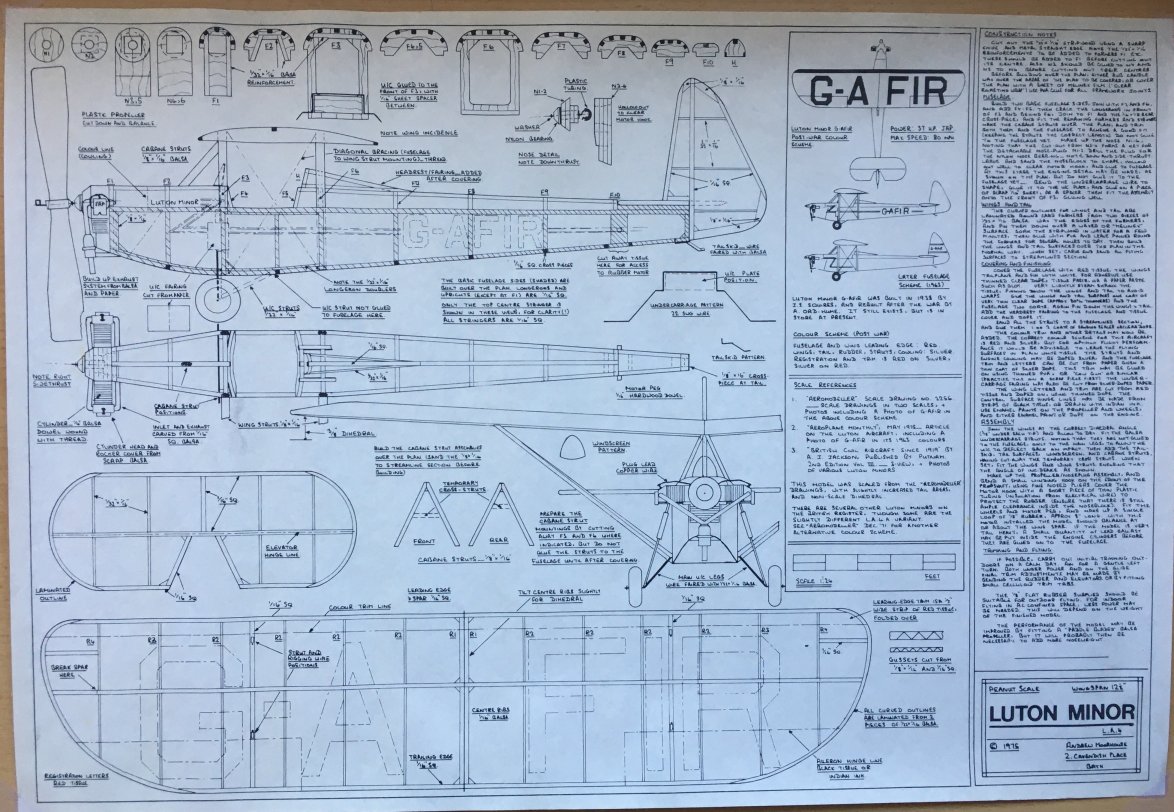
Andrew's plans are beautifully drawn and full of charactor - look at all that hand lettering. The advent of CAD has brought many advantages to flying model plans, but some of the charm of plans like this has definitely been lost.
Back in the 1970's, Peanut scale models were usually built from 1/16" square balsa, which can look a bit over-engineered to modern eyes. As far as a weight penalty goes, I'm not sure there would be very much compared to using 1/20" square, especially as you can use less dense balsa with the larger sized strip. If I was going to change anything, then perhaps I would swap the 1/16" square rear upper stringers with 1/32" x 1/16" placed on edge. The laminated wing and tailplane tip outlines are a sophisticated touch. I might move up the rear peg anchorage up a bay (or maybe even two) to help with balancing the model and reduce the risk of rubber bunching at the rear. I would also suggest steaming in the curvature to the front of the lower longerons before building the fuselage halves to remove the risk of distortion later.
I think this a very nice design of a pretty little aircraft, but it's one achilles heel for competitions is that short undercarriage - a take-off is going to be impossible.
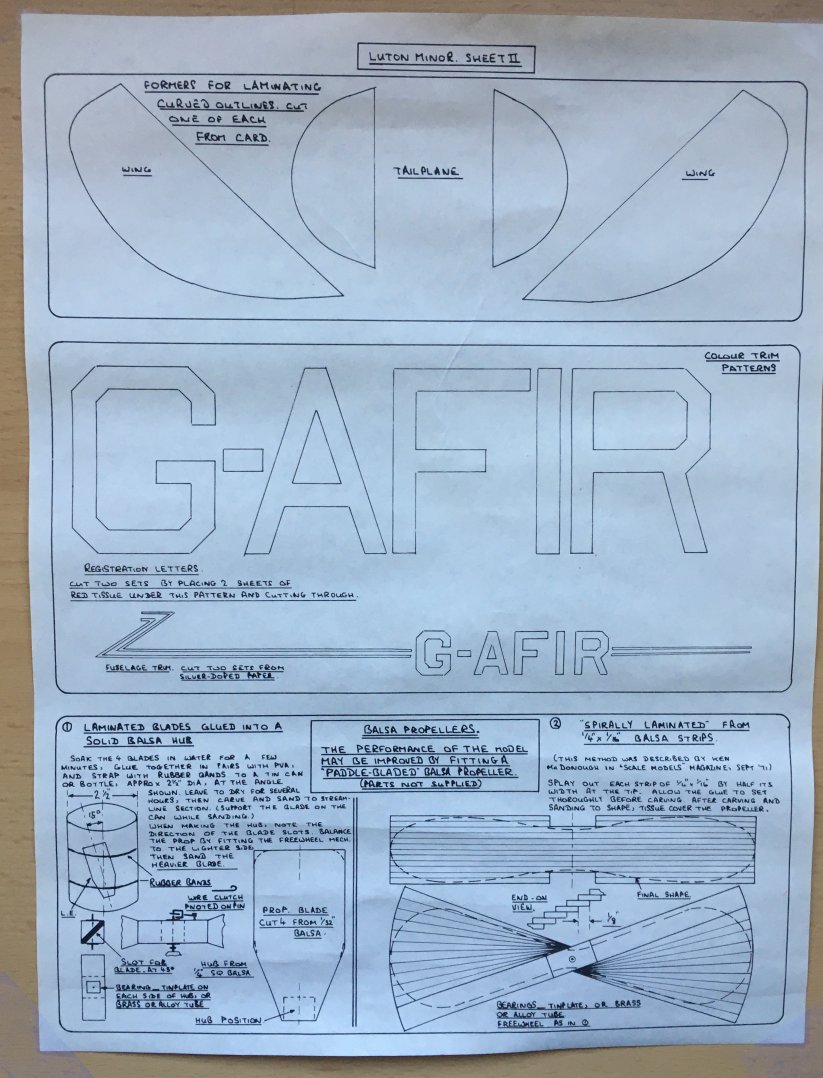
Here is plan sheet two, with the jigs for the laminated wingtips, patterns for the markings and some very useful information on constructing alternative balsa propellers.
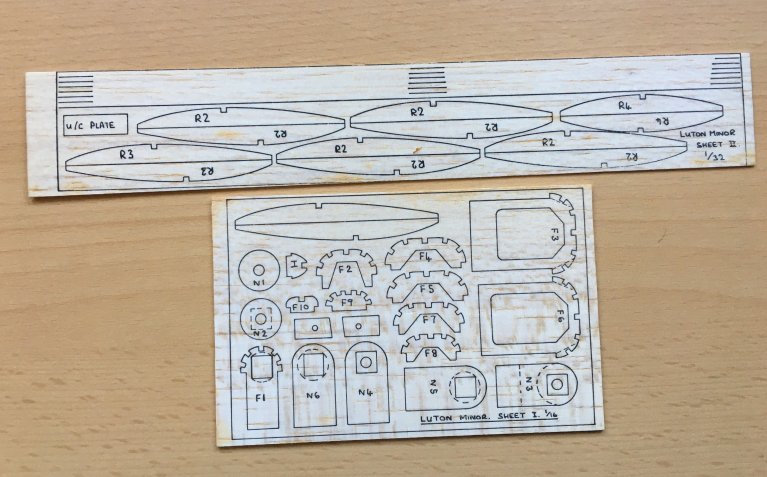
The sheet wood is very sharply and precisely printed - one sheet of beautiful light 1/16" quarter grain and an equally nice piece of 1/32" B grain. The strips for laminating the wing and taiplane tips have to be cut from this latter sheet.
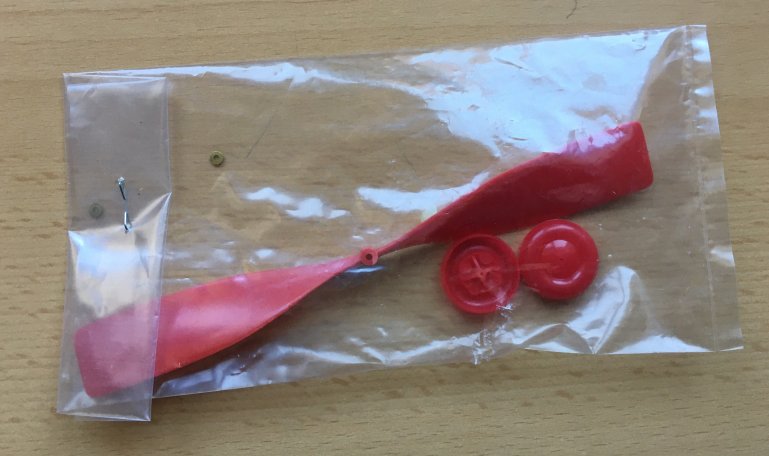
This is the little bag of hardware in the kit. The choice of a Sleek Streak plastic prop was rather inspired based on what was available at the time - they are reasonably efficient and easily trimmed to the desired diameter. Not so sure about the backless wheels though - as well as looking dodgy from the wrong side they are made of polyethylene so paint adhesion is very poor. On a pair I have in my spares drawer, simply flexing the plastic was enough for all the black enamel paint to fall off. So, probably best to make balsa replacements.

Here is the plan for the peanut scale Currie Wot, dated 1977, so presumably released after the Luton Minor. The full size aircraft was really tiny with a wingspan of only 22 feet, making the peanut 1/20th scale. Construction is (unsurprisingly) similar to the Luton Minor, but despite being a biplane, probably a simpler model to build, as there is no exposed engine and there are no laminated outlines to make. Proportions look good for free flight and it should fly well even with the scale dihedral shown on the plan. Again I would move the rear peg location a bay further forwards and reduce the cross section of the rear upper deck stringers.
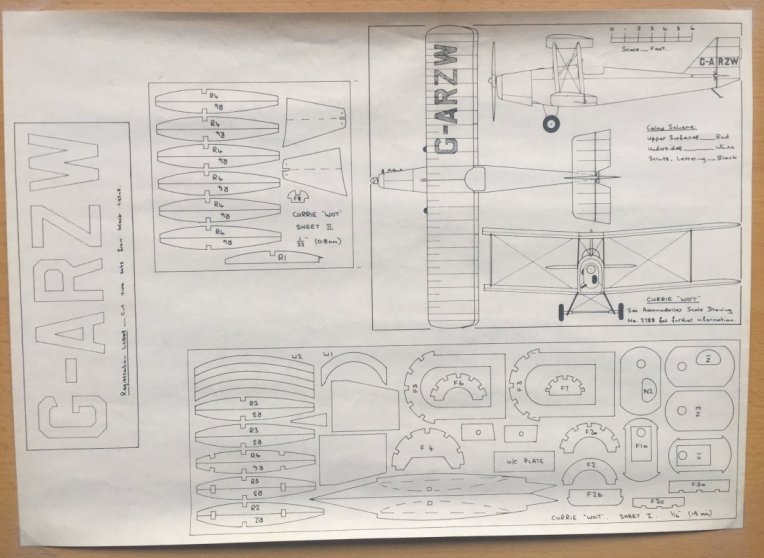
A larger 3-view than for the Luton Minor is supplied, this time on the second plan sheet, which is useful for documentation.
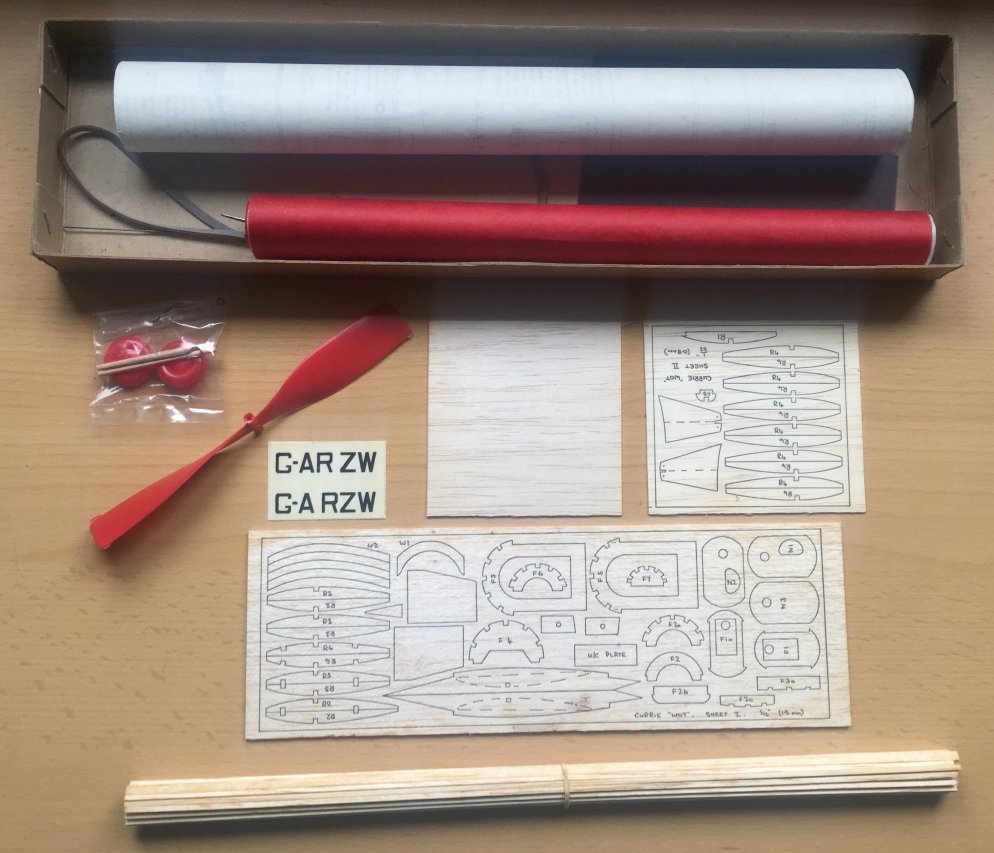
Here are the contents of the Currie Wot kit. The sheet wood quality is again very good - the larger sheet is 1/16" and the two smaller ones 1/32" (the unprinted one is used for sheeting the cowl). Stripwood is a mixture of ligher and stiffer balsa,so needs sorting prior to construction. The tail lettering is printed onto a sticky-backed, rather than waterslide, decal. This needs cutting out close to the lettering before application. The red and white tissue is the same as in the Luton Minor, as is the 1/8" strip rubber and hardware pack.
I really fancy building this one - as well as a nostalgia trip it would be interesting to see how the weight comes out and how well it flies. I also have good references for G-ARZW in this red and white scheme.
The kits do come up on auction sites now and again, so definitely worth looking out for, however plans for all four of the kits are available to download from www.outerzone.co.uk
Thomas Designs 24" span Piper Vagabond
Bluebottle Squadron 1/24 scale Reggiane Re 2000
Peck Polymers Peanut Scale Andreason BA4-B
Diels Engineering 1/24 scale Curtiss SB2C Helldiver
Small Flying Aeroplanes "Golden Edition" plan pack for the Albatros D.II
Easy Built Models 25" span Waco N
More Small Flying Aeroplanes plan packs including the "Golden Edition" Sopwith Pup
Vintage Model Company 18" span Jodel D.18
Back to kit review index page
Back to home page